Assessment of Student Learning Coordinator
Liz Medendorp
Academic Building 250W
719-549-3376
liz.medendorp@pueblocc.edu
Assessment of Student Learning
Pueblo Community College is committed to our students’ success, and assessment is a critical part of our strategy to continuously improve student learning and ensure that PCC students are fully equipped with the valuable skills and knowledge they will need to be successful in their future endeavors.
Assessment of Student Learning is a comprehensive initiative to evaluate student learning across the college with respect to particular goals and outcomes that we value and desire for our students, with the ultimate aim of strengthening our programs by offering students plentiful and varied opportunities to develop, reinforce, and master those competencies throughout their studies at PCC.
The process of assessment is ongoing and cyclical, following these core steps:
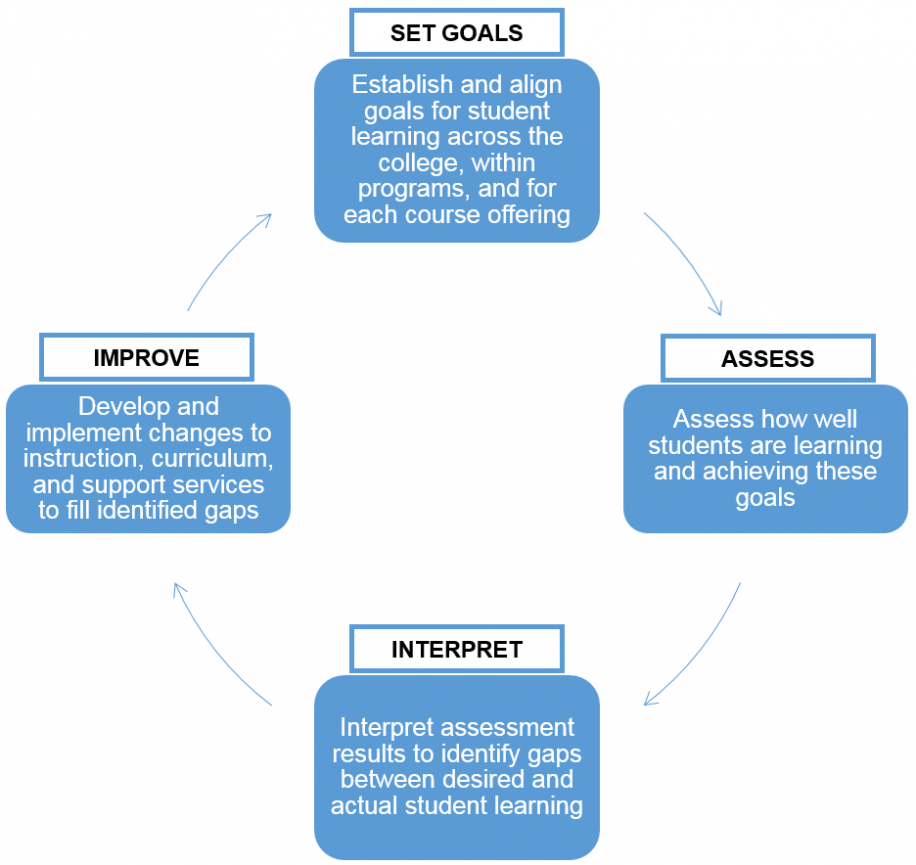
Successful and meaningful Assessment of Student Learning is collaborative and faculty-driven, requiring the participation of all who are interested in the quality of the educational experience we offer at Pueblo Community College, including students, faculty, administrators, and community partners.
PCC Assessment Blog
Discover a range of assessment materials including our shared goals as an institution, rubrics for assessing core learning outcomes, current activities, training and support resources, recent assessment results, and future plans for improvement.
The broader, college-wide goals for student learning are known as Institutional Student Learning Outcomes (ISLOs). All programs at Pueblo Community College emphasize experiences that promote learning in these six core areas:
- Critical Thinking & Problem Solving: the ability to interpret and analyze information, explore implications, construct logical conclusions, and consider alternate perspectives and solutions.
- Effective Communication: the ability to organize and express ideas clearly, purposefully, and compellingly, attending to the needs of the audience and following disciplinary conventions.
- Quantitative Reasoning: the ability to perform computations, represent and interpret numerical information, and formulate reasonable solutions through quantitative analysis.
- Literacy: the ability to recognize, locate, evaluate, and select suitable information and materials for the application of proper methods in order to accomplish tasks.
- Professionalism: the ability to demonstrate accountability, personal growth, integrity, and professional behavior.
- Social Consciousness: the ability to participate productively in a diverse global society through effective interpersonal skills, cultural awareness, civic responsibility, and equitable and inclusive practices.
- Assessment of Student Learning Resources MyCourses Course
- eLumen Login
- Reference U:drive for reports, forms, etc.